San Marino
Stone towers and republican traditions meet wooded hills, village life and regional flavours.
Worth coming back!
Wanderlama keeps growing with new destinations, helpful information and exciting features. Check back soon and discover what is new!
Travel to San Marino
San Marino is an independent republic entirely surrounded by Italy, near the Adriatic coast between Emilia-Romagna and Marche. Its territory includes nine municipalities, known as castelli, with hill villages, woodland, vineyards and farmland beyond the capital. The founding story of Saint Marinus in AD 301 belongs to tradition, while its republican institutions have documented medieval roots.
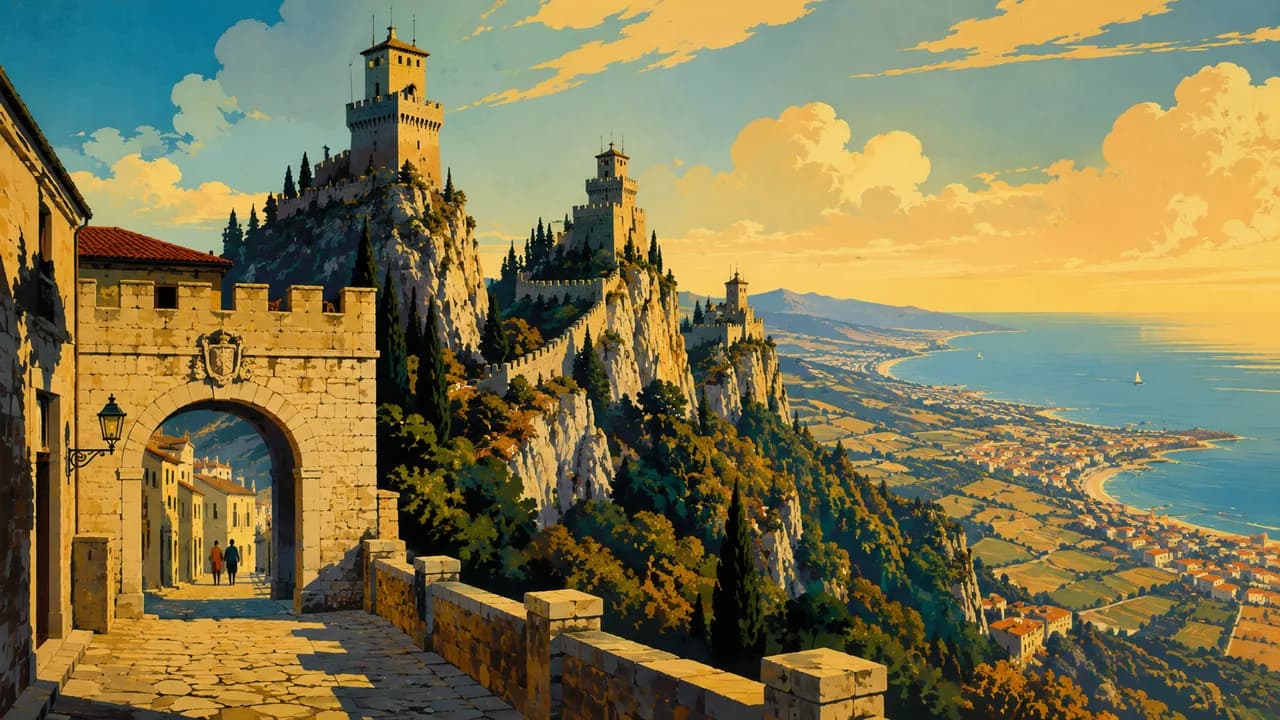
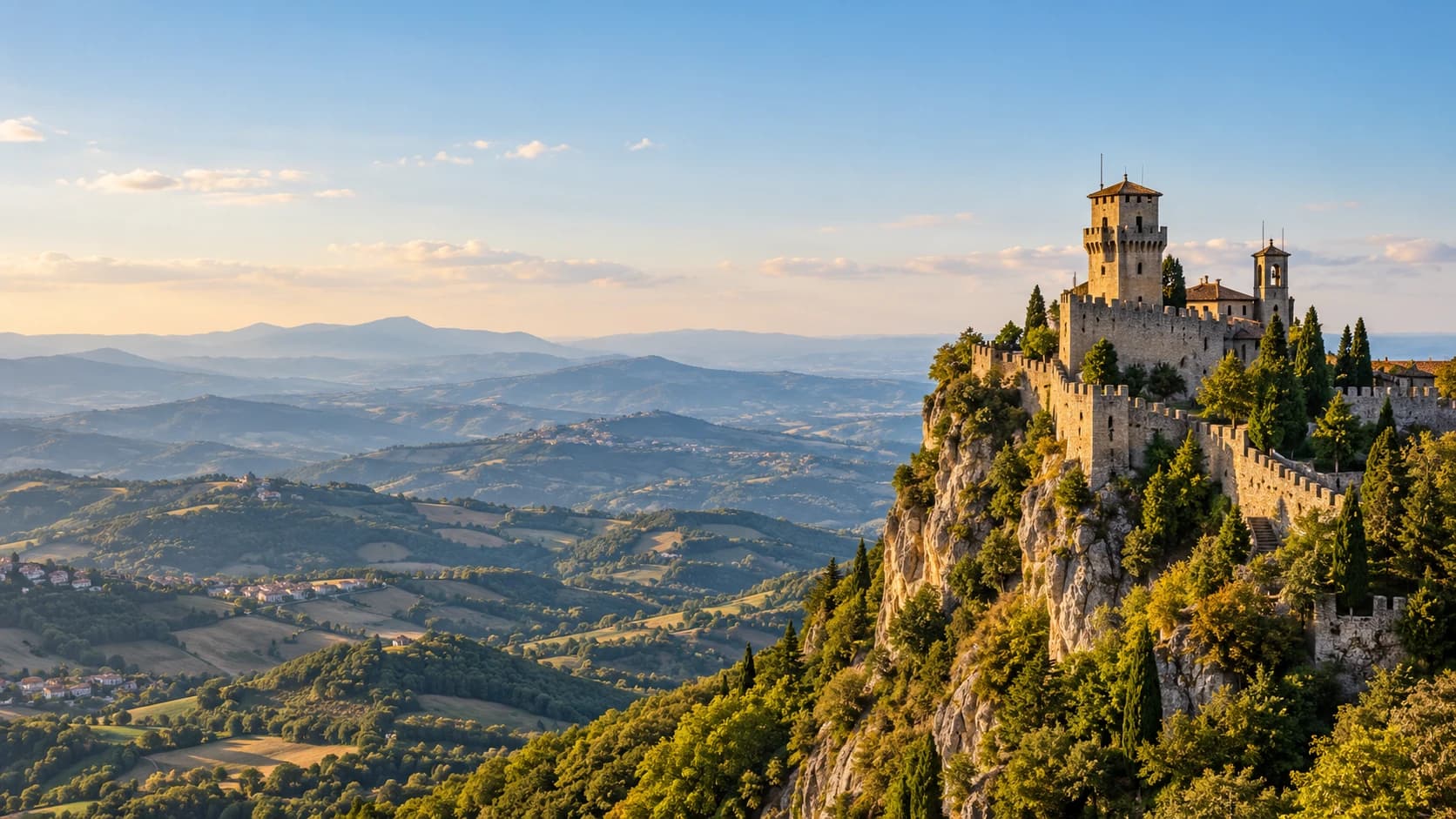
The capital, Città di San Marino, rises along Monte Titano. Guaita, Cesta and Montale mark its ridge, linked by paths and views towards the surrounding hills and, in clear conditions, the Adriatic. Montale can only be viewed from outside. The UNESCO property encompasses the historic centre, Monte Titano and Borgo Maggiore’s old market area. Restorations and reconstruction also shaped today’s medieval-looking streets.
Piazza della Libertà and the Palazzo Pubblico introduce the republic’s civic identity, alongside the Basilica of Saint Marinus. The two Captains Regent take office for six-month terms, and crossbow displays and flag-waving preserve local ceremonial traditions. Borgo Maggiore offers a contrasting market-town setting below the ridge, connected to the capital by cable car and the historic Costa dell’Arnella walking route.
Beyond the main monuments, Serravalle combines an old centre with contemporary commercial life. Montegiardino’s village and gypsum trail reveal rural and industrial history. The Cammino del Titano and routes around Canepa explore woods, valleys and rocky slopes. These paths provide a different perspective from the capital’s shops and viewpoints, with terrain and difficulty varying between itineraries.
Fresh pasta, piadina, local olive oil and wines reflect farming traditions shared with neighbouring regions. Torta Tre Monti adds wafers with cocoa and hazelnut cream. Rimini provides a practical gateway, but an overnight stay leaves more time for villages and evening streets. Allow for steep lanes, steps and exposed paths. Check weather, trail conditions, museum access and current bus and cable-car services before travelling.
AI edited
- 9
- Municipalities San Marino is divided into nine municipalities, known as castelli. The capital is one of them. These are administrative communities, not nine individual castles to visit.
- ≈ 34,200
- Population The national statistics office counted 34,154 registered residents on 31 March 2026. This dated total excludes the separately recorded population of temporary residents and visitors.
- 61.19 km²
- Area Visit San Marino gives a national area of 61.19 km². The landlocked republic is entirely surrounded by Italy.
- Italian
- Language Italian is the official language. The Italian flag here identifies the language, not San Marino’s nationality.
- Local dialect
- Other languages The local Sammarinese dialect forms part of regional cultural life. It is distinct from the official-language role of Italian. Visitor-language availability varies by provider.
- Euro (EUR)
- Currency San Marino uses the euro. Locally issued euro coins share the common currency. Confirm payment methods with individual businesses.
- C · F · L
- Socket types Type C, F and L plugs and sockets are used, with 230 V at 50 Hz. Italian type L has different pin sizes. Check the actual socket and your device’s requirements.
- San Marino
- Capital The city of San Marino, also called Città di San Marino, is the capital of the republic. Its clock follows Europe/San_Marino.
- Right-hand traffic
- Driving side Traffic keeps right. Historic pedestrian streets, steep approaches and parking arrangements require planning. Check access restrictions before driving towards the old town.
- UTC+1 / UTC+2
- Time zone The whole country uses one time zone, UTC+1 in winter and UTC+2 in summer, following Central European seasonal changes.
- 1
- UNESCO cultural site UNESCO lists one cultural World Heritage property, San Marino Historic Centre and Mount Titano, inscribed in 2008. The towers and Borgo Maggiore’s historic market area belong to this inscription rather than counting as separate properties.
San Marino on the map

Map data: geoBoundaries (CC BY 4.0), © OpenStreetMap contributors (ODbL), Natural Earth
Climate and best time to travel
San Marino has warm summers and cooler winters, with exposed hilltop conditions differing from the nearby coast. Spring and autumn often suit walking and village visits. Summer can be hot and busy, while winter can bring fog, frost or occasional snow. Rain and wind can affect ridge paths in any season. Museums and restaurants provide indoor options, subject to opening arrangements. Montale is exterior-only. Check trail conditions, footwear, monument access and cable-car services. Ceremonies and crossbow displays follow specific calendars rather than taking place every day. Month chips indicate typical planning windows, not guaranteed weather or event dates.